Guide
Sub-Zero Maintenance Routine for Rancho Santa Fe Homes
Sub-Zero maintenance is a handful of jobs on a calendar: vacuum the condenser every six to twelve months, replace the water filter after 750 gallons or twelve months, change the air purification cartridge about once a year, wash the door gaskets with mild soap, and descale any undercounter ice maker every three to six months depending on the model and the water. The question owners most often type, how to clean the water dispenser, has a short answer: wipe the spout surround and drip tray with warm soapy water on a soft cloth, rinse, dry, and after every filter change let the dispenser run for two minutes so the new cartridge flushes clean. In Rancho Santa Fe these chores carry extra weight. Much of the tap water across San Diego County is imported and hard, which loads ice makers and dispensers with scale, and a kitchen in The Covenant or Fairbanks Ranch that pairs a built-in refrigerator with an undercounter ice maker and a wine column has three schedules to track, not one.
A maintenance calendar you can keep
Almost everything that keeps a built-in running quietly is quick and cheap, but it only works if it happens on time rather than when something starts to smell or drip. The intervals below come from Sub-Zero's own use and care material, so put them on the same calendar you use for smoke detector batteries and let the reminders do the remembering.
- Condenser: every six to twelve months, sooner with pets in the house
- Water filter on Classic (CL) and Designer (DET, DEC) models: at 750 gallons (2,839 L), at twelve months, or when the indicator lights
- Air purification cartridge: roughly once a year
- Door gaskets, stainless and interior: whenever they look dull, sticky or spotted
- Undercounter ice maker: clean and sanitize every three to six months, plus a filter every six months on a UC-15I
- Wine storage: clean the condenser if the cabinet runs warm and three months have passed since the last time
Cleaning the condenser the right way
The condenser is the radiator that sheds the heat pulled out of the food compartments, and a felt of dust across it makes the compressor run longer and hotter every hour of the day. On Classic (CL) units it sits behind the flip-up grille; on Designer (DET, DEC) units it hides behind the kickplate at floor level, held on by two screws. Turn the refrigerator off at the control panel first, put on gloves because the fins are thin and sharp, and run a vacuum with a soft brush attachment in the same direction as the fins, never across them. Bent aluminum fins choke airflow just as badly as dust does. Sub-Zero says chemical condenser cleaners are not needed and does not recommend them, so the vacuum is the whole kit. A refrigerator younger than six months can skip this job for now. Homes with dogs or cats should stay near the six-month end of the range, and so should any kitchen that collects fine dust when the Santa Ana winds push through in the fall.
Water filter, ice and the dispenser
Filtered water is the part of ownership people forget until the ice turns cloudy or the glass fills slowly. On Classic (CL) and Designer (DET, DEC) models the filter is rated for up to 750 gallons or twelve months, and the signs that it is spent include the indicator, weaker pressure at the dispenser, and cubes that come out hollow. After fitting a new cartridge, dispenser models should run water for two full minutes, while models without a dispenser should throw away the first two full bins of ice, which clears trapped air and loose carbon from the fresh filter. For the dispenser itself, a soft cloth dampened in mildly soapy warm water is all the spout surround and drip tray need, a soft brush loosens mineral crust on the tray grate, and a clean rinse and dry towel finish it. Hard water leaves white spotting here fast, and the instinct is to grab vinegar, but Sub-Zero tells owners to keep vinegar and alcohol-based cleaners away from its refrigerators; baking soda in warm water does the same job safely.
Gaskets, stainless and the interior
Door gaskets do the quiet work of holding cold air in, and a gasket coated in spilled juice or mildew stops sealing well long before it ever tears. Turn the unit off, then wash the gasket with mild detergent and water on a soft cloth. A paste of baking soda and water lifts stubborn stains, and for mold or mildew Sub-Zero allows a mix of one part bleach to ten parts water. Leave vinegar and rubbing alcohol out of the bucket, since both are on the brand's avoid list. The stainless exterior wants a nonabrasive stainless cleaner on a soft, lint-free cloth, worked with the grain rather than in circles, and inside the cabinet plain soap, water and baking soda are enough for shelves, bins and walls.
- Test the seal by closing the door on a strip of paper and pulling it; you should feel drag
- Dry the gasket folds after washing so moisture does not sit in the creases
- Wipe stainless along the grain to avoid swirl marks
Undercounter ice makers
A separate ice maker in a bar or pantry needs more attention than the refrigerator beside it, because scale builds fastest wherever water freezes. Sub-Zero suggests cleaning its Designer undercounter ice maker at startup and then every three to six months depending on how hard the water is, with the reminder set to three months out of the box; each cleaning takes 1/2 cup of descaler and 1/2 tablespoon of sanitizer. Where the tap water is hard, as much of the county's imported supply is, the three-month end makes sense. The DEU1550I and UC-15I share the same cleaner and sanitizer, though neither substitutes for 315I solutions, and the bottle now reads descaler instead of cleaner with no change to what is inside. For the bin and the mold, see cleaning an ice maker without breaking the mold.
- Every six months on a UC-15I, press CLEAN, empty the bin, and once the light starts blinking pour in 4 ounces (115 ml) of cleaner
- Then run it once more, this time with 1 tablespoon (15 ml) of sanitizer; a cycle lasts about 30 minutes and cannot be stopped partway
- Vacuum the UC-15I condenser behind the kickplate on the same six-month schedule
- Replace the filter, part 7042803 (formerly 7012333), every six months, after a long shutdown, or when the red REPLACE FILTER light shows, then hold CLEAN for 6 seconds to reset it and discard the first batch of ice
Wine columns, air filters and long absences
A wine unit that drifts warm usually wants the same first step as a refrigerator: if its condenser has not been cleaned in the past three months, clean it and allow 24 hours before deciding whether it recovered, and know that a brand-new wine unit may bring only one zone down to temperature at a time at first. In the main refrigerator, models with air purification use a single cartridge, part 7042798, a direct replacement for 7007067, and it is the only air filter in the unit. It lasts about a year and scrubs ethylene and odors from the compartment air every 20 minutes, which helps produce keep longer, and because it contains a mercury lamp the spent one belongs at a household hazardous waste drop-off rather than in the kitchen trash. If the house will sit closed for a long stretch, Sub-Zero's advice for Classic (CL) and Designer (DET, DEC) units is to turn the unit off at its control panel, take everything out, prop the doors slightly open so the interior stays dry, and fit a new water filter before starting it up again; our guide to refrigeration left running in a closed-up house covers the other choice.
When cleaning is not enough
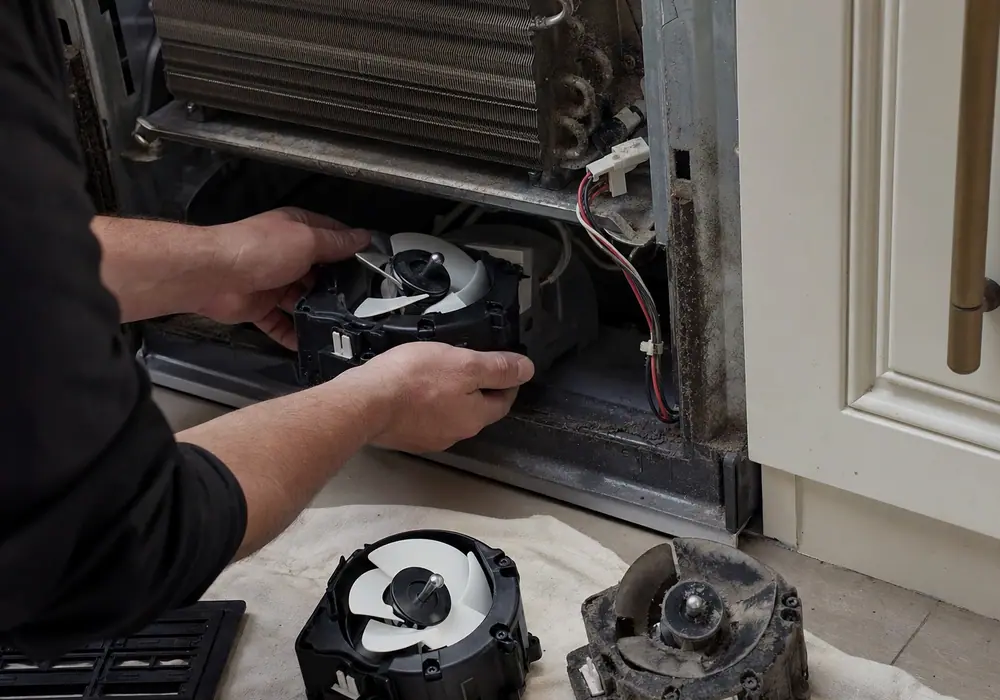
Maintenance prevents most slow declines, but it will not repair a failed fan, a refrigerant problem or a control fault, and a Sub-Zero refrigerator not cooling is often one of those. Sub-Zero draws a clear line: if the fresh-food side reads above 48 degrees while it is set at 38, a condenser cleaning is unlikely to bring it back, and it is time for service. When the freezer holds hard but the fresh-food side creeps up, suspect a fan or the defrost system on that side; the likely culprits are laid out in what stops a warm Sub-Zero from cooling. A professional tune-up adds checks a homeowner cannot easily make: measuring each compartment against its set point, listening to the condenser and evaporator fans, confirming door alignment and gasket contact around the full perimeter, and looking over the drain and the ice maker water line for slow leaks. To arrange one, see preventative maintenance or call (858) 923-5340.
Questions
Answers before you call
How do I clean a Sub-Zero water dispenser?
Wipe the dispenser recess, the spout surround and the drip tray with warm water, a little mild dish soap and a soft cloth, then rinse and dry everything. Skip vinegar and alcohol-based cleaners, which Sub-Zero advises against. If the water tastes stale or the flow has slowed, fit a new filter and run water through the dispenser for two minutes to flush it. That is a two-minute call to Rancho Santa Fe Sub-Zero Appliance Repair Experts on (858) 923-5340.
How often does a Sub-Zero condenser need cleaning?
Every six to twelve months, and closer to six in a home with pets. A unit younger than six months does not need it yet. Use a vacuum with a soft brush, move along the fins rather than across them, and leave chemical condenser sprays on the shelf, since Sub-Zero calls them unnecessary and does not recommend them. Rancho Santa Fe Sub-Zero Appliance Repair Experts, Rancho Santa Fe: (858) 923-5340.
Will cleaning the condenser fix a Sub-Zero that is not cooling?
Sometimes, but not once the fresh-food section has climbed above 48 degrees while set to 38. Sub-Zero says a refrigerator that warm is unlikely to recover from a condenser cleaning alone, so that is the point to book a service visit instead of turning the dial colder. A milder warm spell after a long gap between cleanings can improve once the coil is clear. Say so when you call Rancho Santa Fe Sub-Zero Appliance Repair Experts on (858) 923-5340.
Appliance down in Rancho Santa Fe?
Tell us the brand and what it is doing — we can usually name the likely repair before we arrive.