Guide
Refrigeration left running in a closed-up house: what actually fails
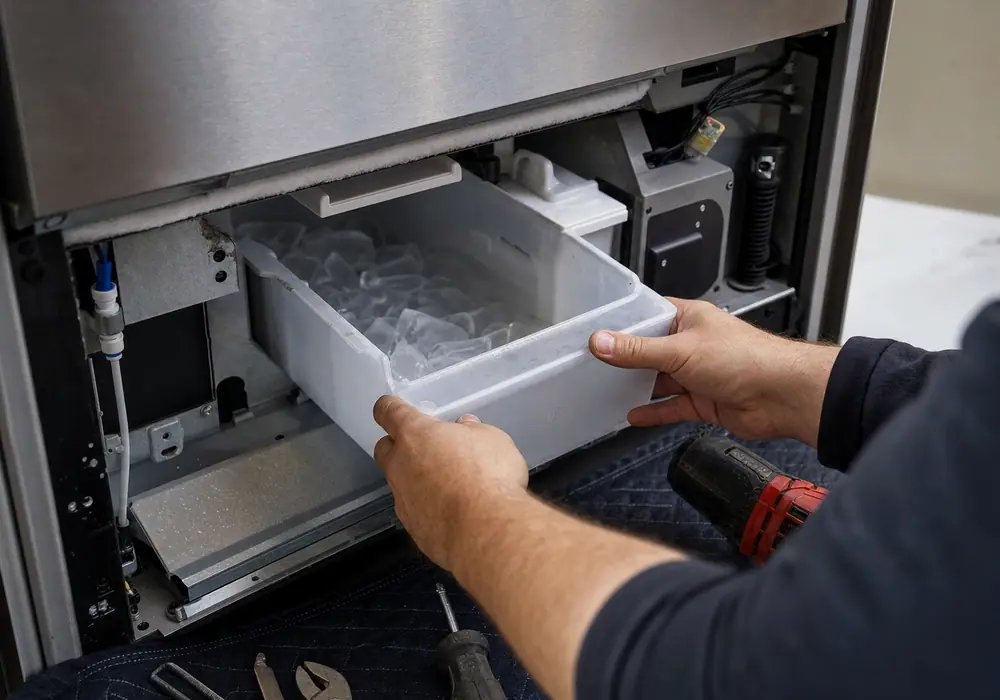
Not the compressor. A built-in refrigerator or freezer is designed to run continuously, and months of steady duty in a quiet house are easier on it than a busy holiday week. What fails is everything attached to the refrigeration that quietly assumes a person is nearby: an ice maker harvesting into a bin nobody empties, a defrost drain that dried out and cemented shut, a door gasket taking a set against a door that never opens, and a water fitting weeping for six weeks with nobody to see it. Every one of those is preventable in about twenty minutes before you lock the door.
Leave it running, with two conditions attached
For most houses the answer is to leave it running, and it is not a close call. Refrigeration is happiest at a steady duty cycle in a stable room, and a cabinet that is switched off and shut is a sealed plastic box that grows odor and mold you will never fully wash out of the liner. The two conditions are what actually decide the outcome. Somebody has to lay eyes on the appliance during the absence, because a unit that quits in week two of a ten-week absence is a full cabinet of spoiled food, and if it is the wine cabinet it is a collection. And the water has to be under control, because the refrigeration side of this appliance cannot damage a building. The quarter-inch water tubing behind it can.
- Running, looked at monthly, water shut off at the ice maker valve: the arrangement that works
- Running with the water on and nobody visiting: the arrangement behind most of the expensive calls
- Switched off, emptied, washed, dried and propped open: fine for a second refrigerator or a freezer
- Switched off with the door closed: the one option that reliably produces a problem
The failures that only happen when nobody is there
None of this is exotic. Each fault is the consequence of a machine running a routine that assumes a person empties the bin, opens the doors and notices a puddle. The ice maker leads every list: it harvests into a bin nobody empties, the cubes sublimate and weld into one block, the next harvest lands on solid ice, and the machine sits with water standing in the mold and the fill trough for weeks. The defrost drain is next. A rarely opened unit puts less humidity through the compartment, so less water passes through the drain, and what does pass leaves residue that dries into a plug. Then the gasket, which is a foam core in a vinyl jacket with a magnet: held compressed for months against a door that never moves, it takes a set, stops recovering, and the first symptom is a compartment that will not hold through a warm afternoon.
- Ice welded into a single block, with the ejector or the bin sensor stalled against it
- A defrost drain that dried out and cemented shut with what was left in it
- Gaskets taking a compression set, worst at the top corner of a heavy panel-fronted door
- A slow weep at a compression fitting on the ice maker feed, running unwitnessed for weeks
- A condenser that kept collecting dust in a closed house with the air conditioning off
- A power event nobody saw, and no way afterward to know how warm the compartments got, or for how long
The round to make before you lock the door
This is twenty minutes of water and air, and it is the highest-value maintenance on a seasonal property. Do it on every refrigeration unit in the house rather than the kitchen alone, because the appliance that ruins a return is almost never the one you use. Prove the drain instead of assuming it: warm water down the drain path, watched through to the tray underneath. And test each door with a strip of paper before you go, because a gasket that is already marginal in June will be leaking humid air into that cabinet every hour you are away.
- Turn the ice maker itself off, then close the water valve that feeds it
- Empty the bin, wash it in warm water, dry it completely, and return it dry
- Clear the condenser through the grille on every unit in the house, including the bar and the pool cabinet
- Run warm water down the defrost drain and watch it reach the tray
- Wipe the gaskets, leave them dry, and check each door on a strip of paper
- Consolidate what is worth keeping into one unit, then empty, wash, dry and prop open the others
- Leave a wireless thermometer inside the cabinet and a water alarm on the floor at the toe kick, and give whoever holds the key the alerts
Coming back, in the right order
Look before you switch anything on. Get down at the toe kick and check the floor and the base of the cabinetry for staining or a soft spot, because water from a built-in travels back and sideways under the cabinet run long before it appears in the open. Then open the doors and use your nose, since a compartment that has stayed cold smells of nothing. Restore the water last, not first, and stand there while you do it with a light on the fitting behind the grille for a full minute. When the ice maker comes back on, throw the first two or three batches away: that ice was made from water that had been sitting in a line and a mold since you left. If the unit was switched off for the season, run it empty for several hours and confirm the compartment temperature with a probe at shelf level before anything goes back in.
- Floor, toe kick and cabinet base checked before power or water goes on
- Doors opened and the compartments checked by smell as well as by the display
- Water restored last, with the fitting watched for a minute under a light
- First few batches of ice discarded, and the bin washed again if it sat with old ice in it
- Shelf temperature verified with a probe rather than read off the panel
- Anything the absence revealed, a soft gasket, a slow drain, a noisy grille, dealt with while it is still cheap
What is cheap, what is expensive, and what is neither
The honest hierarchy is worth knowing before anyone quotes you. Clearing a condenser, opening a drain, aligning a door and replacing a gasket sit at the bottom, and between them they account for most of what an absence causes. The next step up is ordinary component wear: fan motors, thermistors, an ice maker module. Sealed-system work, meaning a leak, a compressor or a line repair, is the expensive end, and it is rarely what an empty house produces. The outcome that costs real money is not the appliance at all. It is a supply fitting that wept for a month under wide plank flooring or stone set in mortar, where the remediation passes the appliance repair several times over and the appliance in question is usually still perfectly serviceable.
- Cheapest: condenser clearing, drain clearing, door alignment, a gasket
- Ordinary: condenser or evaporator fan motor, thermistor, defrost heater, ice maker module
- Expensive: sealed system, compressor, refrigerant leak diagnosis and repair
- The one that is not an appliance bill at all: flooring, subfloor and cabinetry after an unwitnessed leak
Wine storage does not get the same answer
A refrigerator can be emptied and switched off. A wine cabinet cannot, which makes it the one appliance in a seasonal house that has to keep working while nobody watches it, holding the most valuable contents in the building. It is also the quietest failure on the property, because a couple of degrees is a fault on wine storage rather than a tolerance and nothing on the front panel will volunteer it. If one unit gets a remote sensor and a person who actually reads the alerts, make it this one, and have the readings taken at bottle level in each zone whenever somebody is next on site.
- The unit that cannot be switched off, holding the contents that matter most
- A fault that presents as nothing at all: correct display, cold glass, warm bottles
- Worth a wireless sensor at rack level and someone who actually reads it
Questions
Answers before you call
Is it better to leave the refrigerator running or switch it off while we are away?
Leave it running if anybody will check on the house, and shut the ice maker water off before you go. If you do switch it off, it has to be emptied, washed, dried and left with the door propped open. A cabinet powered down and closed for a season develops an odor that soaks into the liner, and washing never fully removes it. Rancho Santa Fe Sub-Zero Appliance Repair Experts answers that on (858) 923-5340.
How often should somebody look at it?
Monthly, and the visit takes two minutes: open both doors and feel the air, look at the floor and the toe kick for staining, listen at the grille for a rattle or a fan that has gone quiet, and read a thermometer left on the shelf rather than the front panel. That is the one thing that turns a spoiled cabinet into a phone call. Call Rancho Santa Fe Sub-Zero Appliance Repair Experts on (858) 923-5340 and ask.
We came home to a freezer full of food and no idea whether the power had been out. How do we tell?
Leave a cup of water in the freezer with a coin resting on top of the frozen surface before you go. If the coin is still on top when you return, it never thawed. If it has sunk to the bottom, everything in that compartment thawed and refroze, and the food should go regardless of how solid it feels now. Rancho Santa Fe Sub-Zero Appliance Repair Experts takes those calls on (858) 923-5340.
Appliance down in Rancho Santa Fe?
Tell us the brand and what it is doing — we can usually name the likely repair before we arrive.