Guide
Undercounter and drawer refrigeration: the heat problem
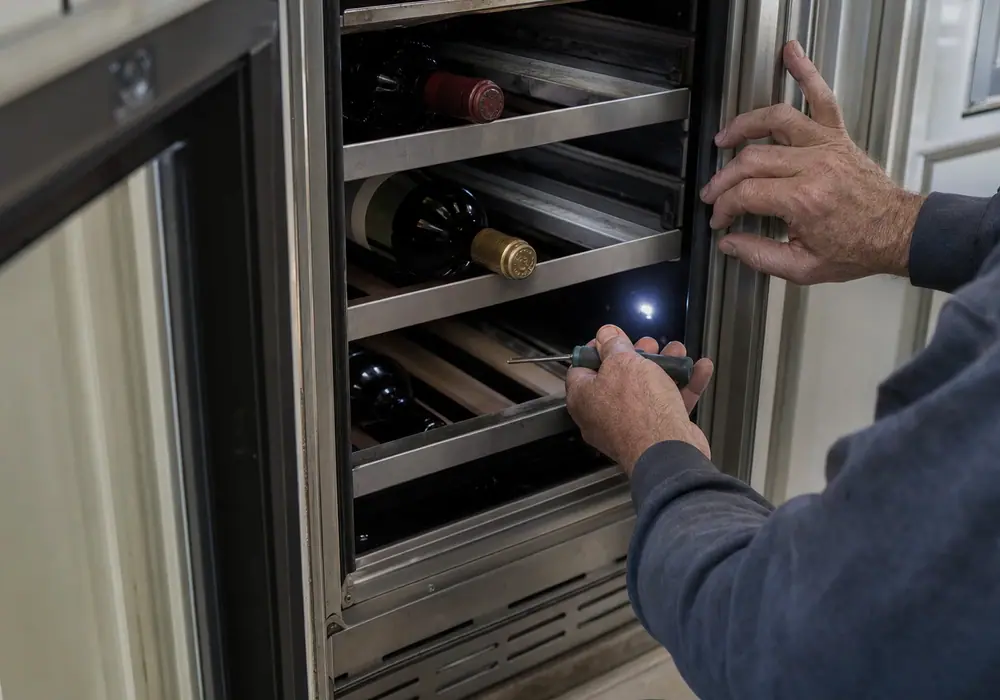
An undercounter refrigerator, a beverage cabinet or a pair of refrigerator drawers that drifts warm has an air problem far more often than a refrigeration one. Each of them carries a complete refrigeration system in the space of a base cabinet and must push its heat out through a grille at floor level, inside cabinetry built to hide it, which is why these units run long, drift warm in summer and wear out sooner than the tall columns in the same kitchen. A large share of the calls on them are not a failed part at all: the machine is re-breathing its own hot exhaust in a boxed-in toe space, or the coil is blanketed with the dirtiest air in the house. The fix is airflow, and it costs nothing.
The same job, in a quarter of the space
An undercounter unit contains everything a full-height refrigerator does. Compressor, condenser, evaporator, fans, controls, and on many of them an ice maker as well, all packed into roughly two feet of width and the height of a base cabinet. The condenser in that space is necessarily small and shallow, which means it depends on air moving across it far more than a big coil does. A large coil with poor airflow still limps along. A small one stops rejecting heat almost immediately. Every model has an ambient range in its specification that it was designed to hold against, and the number that matters is not the temperature of the kitchen but the temperature of the air at the grille. In an island with a dishwasher on one side, that air can sit well above the room it is standing in.
- An island boxed in on all four sides, with the toe space sealed by the base trim
- A dishwasher in the adjacent cabinet, dumping heat and moisture into the same enclosure
- A closed bar or pantry with no return air, where the unit warms the room it must reject heat into
- An indoor-rated unit installed in an outdoor kitchen, where summer ambient is outside anything it was built for
- A custom toe kick or a decorative panel fitted over the grille after the appliance went in
The grille is the whole machine's lungs
Floor level is the dirtiest air in a house. Dust, pet hair, crumbs, mop water and whatever comes off shoes all travel along the floor, and the toe grille is the one part of the appliance breathing it. On top of that, the grille is usually intake and exhaust across a single opening, so if the toe space is enclosed the hot air leaving the coil curls straight back into the intake. The unit then works against air it has already heated, which is exactly the condition that makes an undercounter unit run continuously in July and behave perfectly in January. Pulling the grille and clearing the coil is the first thing worth doing and often the only thing, and the difference on a small coil is dramatic in a way it never is on a full-size column.
- Pull the grille, look at the coil, and clear it with a soft brush and a vacuum rather than a blast of compressed air
- Check whether anything has been fitted over the grille since installation: base trim, a panel, a mat
- Put a hand to the grille while the compressor runs and feel whether air is actually moving
- Look behind and under the cabinet for storage, packaging or a power supply blocking the path
How a heat problem presents as something else
Almost nobody calls to report an airflow fault. They call about a symptom, and the symptom often points somewhere expensive. A beverage cabinet that holds through the winter and drifts three degrees warm from June is the classic. So is a unit that runs constantly and never seems to shut off, a drawer that is cold at the bottom and warm at the top, an undercounter ice machine whose production falls off a cliff during the one week of the year people want ice, and condensation appearing on the front of the drawers or the inside of a glass door. Ice output on any of these depends on heat rejection before it depends on the ice maker, which is why a bin that empties faster than it fills points at the coil first.
- Holds in winter, drifts warm in summer: heat rejection, not refrigeration
- Runs almost continuously with the room at a normal temperature: coil, fan or recirculation
- Ice production collapses when the house is busy and the doors are open: same cause
- Condensation on drawer fronts or inside a glass door: a gasket, a failed frame heater, or humid air in an enclosed toe space
- Frost building on the evaporator of a drawer unit: usually air leaking past a seal, not a defrost failure
Drawers have faults of their own, and most are mechanical
A drawer seals on four sides against a moving carriage, which is a harder job than a hinged door and a much easier one to get wrong. The gasket takes abuse every time a drawer is loaded, the glides carry the weight of a heavy custom overlay panel plus whatever is inside, and after a few years of that the drawer no longer closes square. A bottle standing a fraction proud, or a package pushed against the back wall over the air outlet, will hold the drawer open by a gap nobody sees and let warm room air in continuously. In an island a drawer also takes knee traffic, which is why the bottom front corner is the first place to check the seal.
- Close the drawer on a strip of paper at each of the four sides and check for drag at all of them
- Look for a package or a bottle blocking the air outlet at the back of the compartment
- Watch the drawer close: if it drops or racks at the end of travel, the glides or the panel weight are the fault
- Check the panel fasteners, since a heavy overlay front works itself loose and pulls the drawer out of square
- Wipe the gasket and the sealing face, because sugar or syrup on either will hold the seal open
What gets measured before anything is replaced
The honest diagnosis on these units starts with air, not parts. Ambient is taken at the grille rather than in the room, because those two numbers can differ by more than a person expects in a boxed-in island. Air entering the coil and air leaving it are both worth reading, since a condenser that is rejecting heat properly warms the air passing through it, and a small difference with a hot coil says the air is not moving. Compartment temperature is read with a probe at the level the food or the bottles occupy, never off the display. Run time gets watched over a window rather than a glance. Where the house holds a second unit of the same kind, the healthy one is a free reference point.
- Ambient measured at the grille, not in the kitchen
- Inlet and discharge air across the condenser compared
- Compartment temperature probed at shelf, drawer or bottle level
- Condenser fan checked for draw as well as for rotation
- Run-time percentage observed rather than assumed
- A matched unit elsewhere in the house used as the control
When it really is the unit, and the arithmetic that follows
Parts do fail on these, and the list is short. Condenser and evaporator fan motors, thermistors, defrost heaters, control boards, door and drawer gaskets, and on glass-door cabinets the low-wattage heater that keeps condensation off the frame. All of those are ordinary repairs. Sealed-system work is the different conversation. On a full-height column, a compressor or a leak repair is still a fraction of what the appliance and its installation are worth. On a small undercounter cabinet, the same work is a much larger share of the machine's value, and that genuinely changes the arithmetic. The counterweight is always the opening: these sit in a niche framed, trimmed and paneled around them, so a replacement has to fit the same space and carry the same panel.
- Ordinary parts: fan motors, thermistors, defrost heaters, gaskets, controls, frame heaters
- The expensive class: compressor, refrigerant leak, sealed-system repair
- On a small unit, sealed-system work is a far larger share of its value than on a column
- The offsetting factor is always the opening, the panel and the trim it was built into
Questions
Answers before you call
How much clearance does an undercounter refrigerator actually need?
The specification for your model gives the exact figures. What matters in practice is that the front grille stays completely unobstructed and the toe space is not sealed off at the back or the sides, because these units take air in and push it out across the same opening. Sealing the enclosure is what makes a unit re-breathe its own exhaust. Rancho Santa Fe Sub-Zero Appliance Repair Experts takes those calls on (858) 923-5340.
The beverage cabinet is fine all winter and warm every summer. Is the compressor failing?
That pattern points the other way. A failing sealed system does not recover overnight or take December off. A machine that only struggles when the ambient rises is short of airflow or heat rejection capacity: a blanketed condenser, a grille that has been covered over, a stalled condenser fan, or an enclosure with no path for hot air to leave. That is a two-minute call to Rancho Santa Fe Sub-Zero Appliance Repair Experts on (858) 923-5340.
Can I clean the condenser myself?
Yes, with the power off first, because the condenser fan sits directly behind the coil. The grille comes off with a couple of screws or a firm pull, and a soft brush with a vacuum is all that is wanted. Work gently; the fins bend easily. Avoid compressed air, which drives debris deeper, and leave anything needing a panel or shroud removed to a technician. Rancho Santa Fe Sub-Zero Appliance Repair Experts, Rancho Santa Fe: (858) 923-5340.
Appliance down in Rancho Santa Fe?
Tell us the brand and what it is doing — we can usually name the likely repair before we arrive.